CLP vs. GHS: Key Differences and What They Mean for Your Business
(Comparing EU CLP and the Globally Harmonized System for product compliance)
Navigating chemical compliance can feel overwhelming. With different regulations across regions, ensuring that your products meet the right classification, labeling, and safety standards can be a complex and time-consuming task. Two major regulatory frameworks: the Globally Harmonized System (GHS) and the EU Classification, Labelling, and Packaging (CLP) Regulation, are designed to standardize chemical safety. While they share the same foundation, key differences impact how businesses operate, especially in the European market.
Failing to comply with the correct standards can lead to product recalls, legal penalties, and market restrictions. If you manufacture, distribute, or export chemical products, understanding how CLP and GHS differ is essential to avoid costly mistakes.
In this guide, we’ll break down:
1. What GHS and CLP are
2. How they differ in practice
3. What these differences mean for your business
Understanding GHS: The Global Standard
The Globally Harmonized System (GHS) is a worldwide framework developed by the United Nations (UN) to create a unified system for classifying chemical hazards and communicating them through labels and Safety Data Sheets (SDS). Before GHS, different countries had their own standards, which created inconsistencies and made global trade more challenging.
Though a global standard, GHS is not legally binding. Instead, it serves as a model framework that countries can adopt and adapt according to their own regulations. This results in varying levels of GHS implementation worldwide.
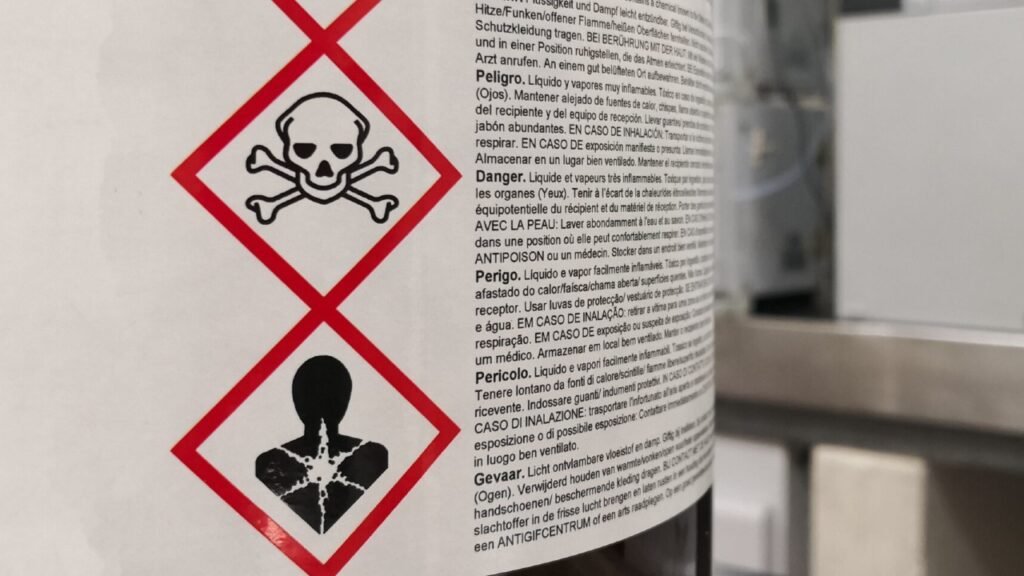
Key Elements of GHS
- Harmonized hazard classifications for chemicals and mixtures
- Standardized hazard pictograms, signal words, and hazard statements
- Uniform Safet Data Sheets (SDS) format for chemical safety documentation
- Guidelines for packaging and transport of hazardous chemicals
Since 2003, many countries, including the US, Canada, China, and the EU, have adopted GHS. However, each jurisdiction tailors it differently, leading us to CLP.
What is CLP: the EU’s Implementation of GHS
The Classification, Labelling, and Packaging (CLP) Regulation (EC No. 1272/2008) is the EU’s version of GHS. It legally applies to all substances and mixtures placed on the EU market. While CLP follows the same basic principles as GHS, it includes additional rules specific to the EU regulatory framework.
The primary objectives of CLP are to:
- Ensure hazardous chemicals are correctly classified based on their risks
- Standardize labels so that hazards are easily recognized across the EU
- Regulate packaging to minimize risks of exposure
- Enhance workplace and consumer safety through proper hazard communication
Unlike GHS, which serves as a guideline, CLP is legally binding in the EU. Any company placing chemical products on the EU market must comply with CLP regulations.
Key Differences Between CLP and GHS
While GHS and CLP share the same foundation, several key distinctions affect businesses operating in or exporting to the EU.
One of the most significant differences is legal status. GHS serves as a flexible guideline, whereas CLP is an enforceable regulation. This means that businesses selling in the EU must adhere strictly to CLP requirements, even if they already follow GHS elsewhere.
The scope of application also differs. GHS is a global framework, but each country implements it differently. In contrast, CLP applies uniformly across all EU member states, ensuring consistency in classification, labeling, and packaging rules.
When it comes to hazard classification and labeling, CLP is often more stringent. Some substances classified as less hazardous under GHS may be subject to stricter classification in the EU. CLP also mandates additional labeling elements, such as the Unique Formula Identifier (UFI), which links hazardous mixtures to Poison Centre Notifications (PCN). Furthermore, CLP enforces specific packaging requirements, including:
- Child-resistant closures
- Tactile warnings for the visually impaired
- Multilingual labeling to accommodate diverse EU markets
Safety Data Sheets (SDS) compliance also differs. Although both GHS and CLP follow standardized formats, the EU requires additional details, such as exposure scenarios for hazardous substances. Businesses exporting to the EU must ensure their SDS documentation aligns with these added requirements.
Another key distinction lies in regulatory updates and revisions. The UN revises GHS every two years, but countries decide how quickly they implement changes. The EU tends to adopt stricter classifications ahead of global GHS updates, requiring businesses to stay vigilant and adapt to evolving CLP requirements.
By understanding these differences, businesses can navigate compliance more effectively, ensuring their products meet regulatory standards while avoiding legal risks and market disruptions.
What These Differences Mean for Your Business
If you operate in the EU
Compliance with CLP is mandatory. Even if your product complies with GHS standards in another country, it must be reassessed according to CLP. This includes updating labels and SDS to reflect EU-specific requirements, such as hazard pictograms, signal words, and the UFI for hazardous mixtures. You must also ensure that your labels are translated for every market where your product is sold. For hazardous mixtures, you’ll need to submit a Poison Centre Notification (PCN), so emergency responders have easy access to safety information.
Actionable Steps:
- Review all product labels and SDS to ensure CLP compliance.
- Translate labels into all required languages.
- Submit PCNs for hazardous mixtures.


If You Export to the EU
If you’re exporting to the EU, you can’t assume that meeting GHS requirements in your home country is enough. Products must meet CLP’s specific classification rules, which may differ significantly from GHS. For example, some substances may be classified as more hazardous under CLP, requiring updates to labels and packaging.
SDS documentation must meet EU-specific standards, including exposure scenarios. Reusing an SDS from another market might not be sufficient for CLP compliance.
Actionable Steps:
- Check that your classification aligns with EU rules, not just GHS.
- Update labels and packaging as needed.
- Ensure your SDS contains all the required information for EU compliance, including exposure scenarios.
If You Sell in Multiple Markets
Managing compliance across different regulatory systems can be challenging. Since CLP is an adaptation of GHS but with stricter EU-specific rules, businesses often need to meet both GHS and CLP standards.
This can mean:
- Different labels for different regions, as hazard classifications and language requirements may vary.
- Separate Safety Data Sheets (SDS) to ensure compliance with both EU and non-EU regulations.
- Regulatory expertise to navigate differences, since non-compliance can lead to legal penalties, product recalls, or market restrictions.

Need Help with CLP Compliance
We know how complex it can be to navigate these regulations. That’s why we’re here to help you meet CLP requirements effectively. We offer:
- Label compliance checks to ensure all your product labels are EU-ready
- SDS reviews to make sure your documentation meets the latest safety standards
- PCN registration support to ensure your products are fully compliant with EU regulations
By working with us, you can streamline your CLP compliance, avoid costly errors, and ensure that your products meet regulatory requirements in the EU. Get in touch today to discuss how we can help you stay compliant and confident in your chemical product safety.
Conclusion
While GHS and CLP share common principles, businesses must recognize that CLP is more than just an adaptation of GHS, it’s a legally binding regulation with additional requirements.
Proactively aligning with CLP regulations helps businesses protect customers, maintain market access, and stay ahead of evolving regulations. If you need expert guidance, we’re here to help. Reach out today to ensure your products meet the necessary EU standards.
👉 Interested in working together?
info@compliancesafeguard.com
Read more!
PCN 101: How to Navigate the Poison Centre Notification Process in Europe
PCN 101: A step-by-step guide to Poison Centre Notification compliance in Europe. Learn who must submit, which products require PCN, UFI rules, deadlines, and how to stay compliant under CLP.
Understanding CLP: A Complete Guide to Product Classification, Labelling, and Packaging
Learn everything about CLP compliance in the EU: a complete guide to chemical product classification, labeling, and packaging. Ensure safety, avoid penalties, and stay market-ready.